" height="18px" id="uuO70bzEX" width="16px"/></svg>)
Mandatory MFA - Service NSW
Accessibility at scale
When the Notice of Disposal transaction shipped with accessibility issues that had to be fixed in live production, the cost was real — engineering rework, failed WCAG audits, and an experience that was failing users who rely on screen readers and keyboard navigation every day.
But I saw this not as an isolated failure, but as a systemic signal. Service NSW was rebuilding its entire transaction portfolio on TaPaaS — a new design system — and every transaction would be built from the same components and page templates. If accessibility wasn’t embedded at the design system level now, the same issues would replicate across every service we shipped.
I led the work to change that. Using the Notice of Disposal as the reference case, I annotated every component and page template in the TaPaaS library for accessibility, created a repeatable guideline that designers and engineers could use across all transactions, and tested everything with VoiceOver and Microsoft Accessibility Insights. The guideline was adopted across multiple squads — making accessible design the default, not the afterthought.
Online Licence Renewal (OLR) Service Blueprint
Role
Lead Product Designer
Team
Cross-functional: PM, developers, BA, content designer, with close collaboration across the product maintenance squad and Transport NSW SME.
Context
Service NSW, Transport for NSW, NSW Government
Scope
End-to-end service audit and redesign strategy for online licence renewal
Status
Blueprint and strategic recommendations delivered; informing the redesign phase
The biggest takeaway:
senior design work is often about creating the conditions for good decisions to happen, building the shared understanding, the documentation, and the cross-team relationships that allow a redesign to be grounded in reality rather than assumptions. The blueprint wasn’t just an artefact; it was a tool for alignment.
The Business Problem
Online Licence Renewal is one of Service NSW’s highest-volume transactions, used by hundreds of thousands of NSW drivers every year. The promise of the service is simple: renew your licence without visiting a service centre.
But for a significant number of customers, that promise was breaking. Many cohorts, depending on their licence type, class, medical conditions, or other circumstances couldn’t actually complete the renewal online. The problem was that nothing in the flow told them this upfront. These customers would work through multiple pages of forms and declarations, only to learn at a late stage that they needed to visit a service centre in person.
This had a cascading effect:
For customers: wasted time and frustration, especially for those in regional areas or with mobility constraints who then had to make an in-person trip they could have planned for from the start.
For service centres: increased foot traffic from customers who arrived frustrated, having just been rejected by the online flow, adding pressure to already busy locations.
For the organisation: higher cost-to-serve per transaction and a digital channel that was undermining trust rather than building it.
The task I was given: review the entire transaction, find out what’s going wrong, and set the direction for a redesign. But there was a catch.
How I Worked: Cross-Squad Collaboration
The OLR transaction sits at the intersection of Service NSW (which builds and runs the digital experience) and Transport NSW (which owns the policies, regulations, and licence issuance). Understanding the system meant working across both.
Working with the product maintenance squad
There was an existing squad responsible for maintaining OLR and managing the relationship with Transport NSW. I embedded myself with this team — working closely with their engineers to understand the API layer, their QA team to access whatever test data existed, and their product manager to understand business priorities and known pain points. This wasn’t just information gathering — it was building a shared understanding of the system that the squad itself hadn’t fully had before.
Workshops with the Transport NSW SME
I ran several structured sessions with the subject matter expert from Transport NSW, alongside our PM. These workshops served a dual purpose: I needed to understand the regulatory requirements and policy intent behind each part of the flow, but I also used these sessions to collaboratively identify risks, dependencies, and sequencing for upcoming work. Working through this together, rather than just receiving documents, meant we caught regulatory constraints and edge cases early, before they became expensive retrofits in the redesign phase.
Design practice engagement
Within our design squad, I ran weekly design critiques on the OLR work. This served two goals: getting feedback that improved my thinking, and building awareness across the practice for a product that had historically been under-documented and under-understood. By the time the blueprint was complete, the wider design team had context on OLR that would help them contribute to the redesign phase.
Building the Blueprint
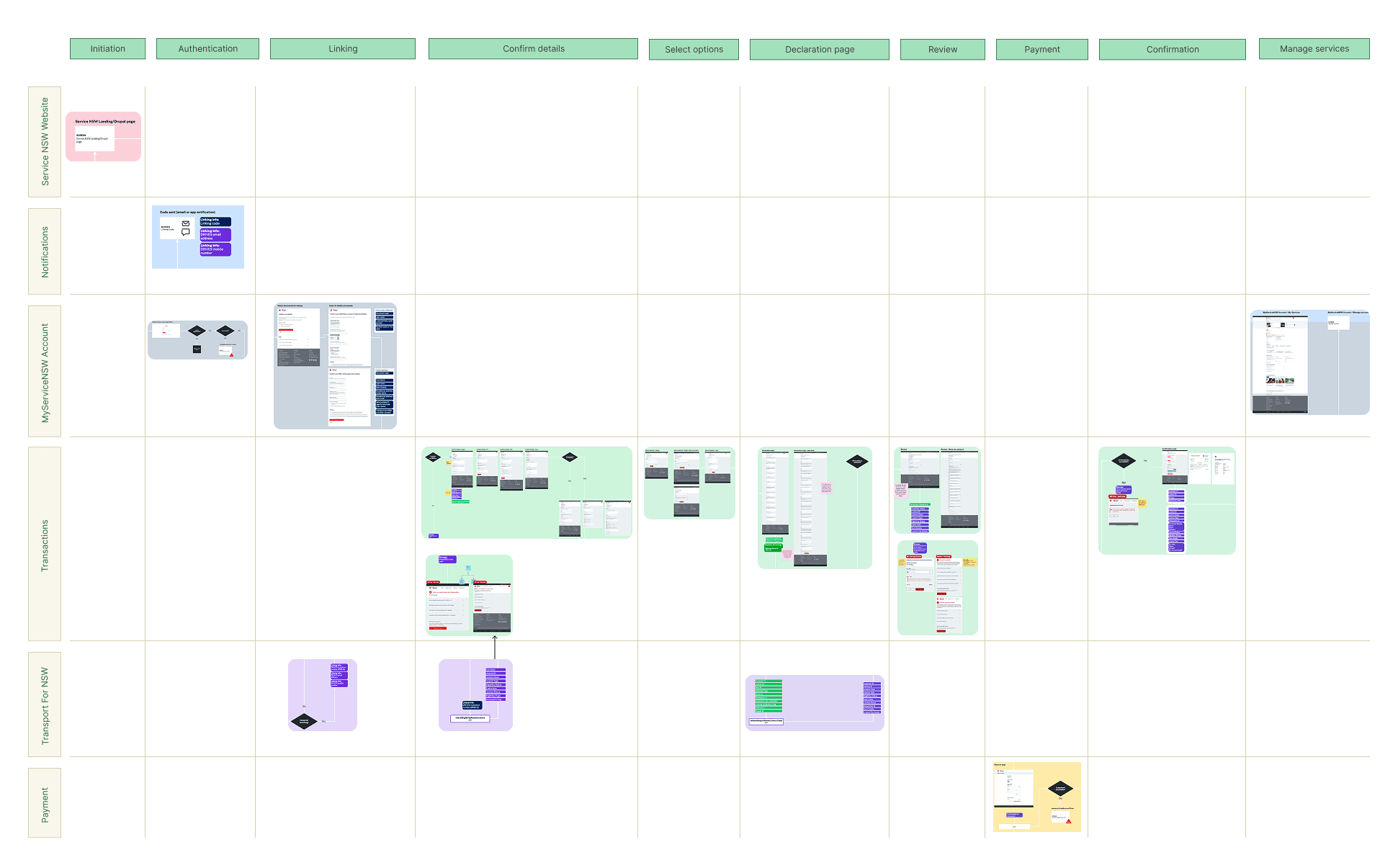
With inputs from all these sources, I constructed a comprehensive service blueprint. This was the central artefact of the project — a systems-level map that connected four layers:
What the customer sees and does at each step
What the front-end displays in response
What API calls are made behind the scenes and what logic governs them
What regulations and policies require at each decision point
Alongside the blueprint, I developed an API-to-scenario map. This linked each eligibility API response to its customer-facing consequence: when the system returns a specific code, what does the customer experience? Where are they sent? What options remain? This mapping had never existed before, and it was essential for identifying where the experience diverged from what the business logic intended.
What the blueprint revealed
With the full picture visible for the first time, three structural problems became clear:
1. Declarations came too late. Customers were filling out lengthy forms before reaching regulatory declaration questions that could disqualify them from renewing online. These weren’t edge cases, they affected meaningful cohorts of drivers. People were investing significant time and effort into a transaction that the system already had enough information to flag as ineligible.
2. No early screening. The transaction didn’t ask filtering questions upfront to route customers into the right pathway. Every customer entered the same funnel, regardless of their licence type, class, or circumstances, and only encountered branching logic deep into the flow. This created unnecessary complexity for both customers and the codebase.
3. No mechanism to redirect. For customers who genuinely needed to visit a service centre, there was no early notification or off-ramp. The system let them proceed through the online flow and only informed them at the final steps. There was no way to say, upfront: “This transaction requires an in-person visit, here’s what you need to bring and where to go.”
"This is a condensed excerpt of the full OLR service blueprint, selected to show the layered structure of the artefact in a portfolio context. The complete blueprint is considerably larger, mapping every API call, eligibility scenario, licence type and class combination, error state, and policy decision point across all renewal pathways. Here, six layers are shown across ten journey phases: the Service NSW website and MyServiceNSW account (customer-facing), Notifications (communication with customers), the Transaction layer (where customer faced eligibility logic pages and conditional flows live), Transport NSW's backend systems (where policy governs decisions), and Payment. Reading it horizontally follows a customer's journey; reading it vertically reveals how many systems are involved in a single customer action — and where misalignments between those systems were causing customers to hit dead-ends late in the flow."
The Strategic Recommendation
Screen early.
Surface deal-breakers first.
Guide customers to the right channel before they invest time in the wrong one.
This was more than a UI suggestion. It was a service architecture principle with three components:
Move disqualifying declarations forward: Ask the questions that determine online eligibility before asking customers for personal details and form data. If a customer can’t proceed online, tell them immediately — don’t waste their time.
Add pre-transaction screening: Before the renewal flow even begins, ask a short set of questions that route customers into the correct pathway for their licence type and circumstances. Show them only the steps that are relevant to them.
Create a graceful off-ramp to service centres: For cohorts that need an in-person visit, provide clear, early direction: what they need, where to go, and why online isn’t available for their situation. Turn a dead-end into a helpful redirect.
The business case was clear: fewer customers falling out late in the flow means less frustration, fewer unnecessary service centre visits, lower cost-to-serve, and a digital channel that actually delivers on its promise.
Navigating Constraints
Regulatory immovables: Certain declarations and questions were legally required. The design challenge was when and how to present them, not whether to include them. This required careful alignment with Transport NSW’s policy team through the SME workshops.
Untestable edge cases: Some licence type and class combinations had no test data available in the staging environment. I documented these as known risks in the blueprint, with recommended validation approaches for the redesign phase, so the team could address them deliberately rather than discovering them in production.
Tight API coupling: The customer experience was driven by backend API responses, meaning any flow change had to respect what the APIs could return. The service blueprint served as a shared reference between design and engineering, making this dependency visible and plannable.
No one to ask: With the original team gone, every design decision in the existing flow had to be reverse-engineered. The workshops with the maintenance squad and Transport NSW SME were essential for distinguishing between intentional design decisions and accumulated drift.
What I Delivered and Its Impact
The outputs of this work went beyond a redesign recommendation. They created foundational knowledge for the organisation:
A service blueprint that became the single source of truth for how OLR actually works — used by design, engineering, product, and policy stakeholders across both squads. For the first time, the full transaction was documented in one place.
An API-to-scenario map linking every backend eligibility response to its customer outcome — giving the engineering team a reference they could use to scope the technical effort for the redesign.
A gap analysis identifying misalignments between policy intent, system behaviour, and user experience — prioritised by impact to guide the redesign roadmap.
A strategic design direction centred on early screening and upfront declarations — validated through workshops with the Transport NSW SME and the product team to ensure regulatory and technical feasibility before committing to the redesign.
A risk and dependency register developed collaboratively with the PM and SME that informed sprint planning for the redesign phase, reducing the likelihood of costly mid-sprint discoveries.
The sprint planning work done through the SME workshops had a tangible impact: by surfacing regulatory constraints, edge cases, and API dependencies before the redesign began, we significantly reduced the risk of retrofitting — going back to rework designs that didn’t account for real-world constraints.
What This Project Taught Me
This was a project where the most valuable design work happened before a single screen was drawn. The blueprint, the scenario map, the stakeholder workshops were the interventions that changed the direction of the redesign and created shared understanding across two organisations.
If I’m being honest about what I’d do differently: I would have pushed to involve the Transport NSW SME even earlier. Some of the regulatory nuances I spent a week reverse-engineering from documents could have been clarified in a early conversation. I was thorough in my document review, but I initially underestimated how much faster collaborative discovery is than solo analysis.
I’d also advocate for a more structured approach to the untestable edge cases. I documented them as risks, but in hindsight I could have proposed a lightweight process for validating these scenarios, perhaps through desk walkthroughs with the QA team, rather than leaving them as open items for the next phase.
The biggest takeaway: senior design work is often about creating the conditions for good decisions to happen, building the shared understanding, the documentation, and the cross-team relationships that allow a redesign to be grounded in reality rather than assumptions. The blueprint wasn’t just an artefact; it was a tool for alignment.
The biggest takeaway:
senior design work is often about creating the conditions for good decisions to happen, building the shared understanding, the documentation, and the cross-team relationships that allow a redesign to be grounded in reality rather than assumptions. The blueprint wasn’t just an artefact; it was a tool for alignment.